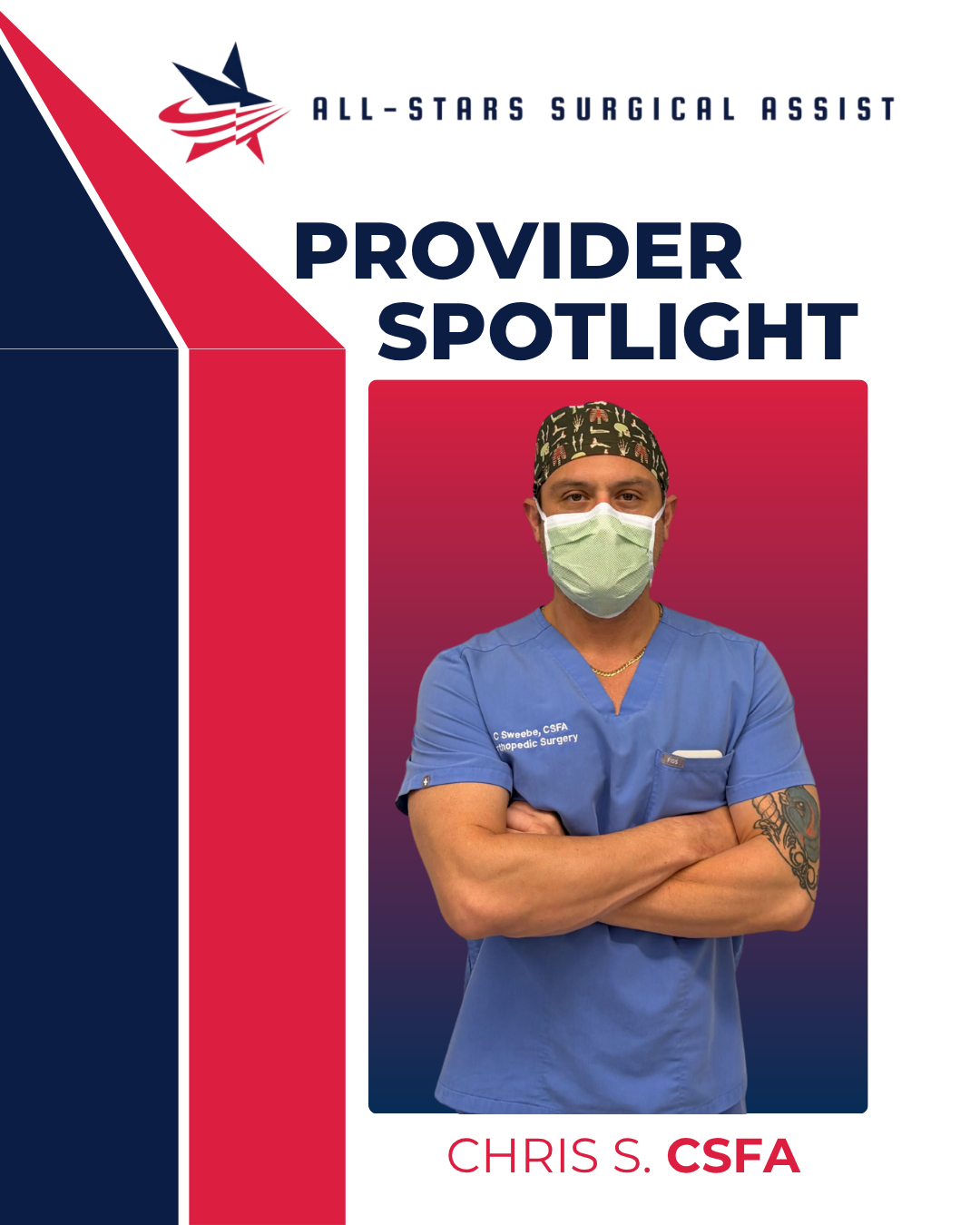
A Provider Spotlight: Chris Sweebe, CSFA
Based in the Southeast, Chris Sweebe has built something most first assists work toward over time: a model that combines independence, structure, and more predictable income across cases.
From Firefighter to First Assist
Chris’s path into surgical first assisting started in Michigan as a paramedic firefighter before joining the Air Force, where he trained as a scrub tech. Through the military’s tuition assistance program, he attended Meridian in Nashville, one of the leading first assist programs in the country.
After completing his training, he began working with surgeons he met during his service and transitioned fully into first assisting by 2010. More than 15 years later, he continues to work cases while building a broader network of first assists across the Southeast.
Building a Surgical First Assist Group From the Ground Up
Chris did not originally plan to start a group. After working with an existing organization that took a percentage without providing meaningful infrastructure, he decided to build a better system himself.
That decision led to the creation of Precision Surgical Resources, now operating across Alabama, Georgia, Mississippi, Tennessee, Louisiana, and expanding into additional states.
What differentiates Precision is its focus on structure without forcing employment.
Structure Without Sacrificing Independence
Rather than placing providers into rigid systems, Chris focuses on helping first assists build their own setup locally, from surgeon relationships to billing workflows.
“We help you build structure specific to your area. All you have to do is do the surgery and submit your cases. We handle the rest”
This model allows first assists to stay independent while still having the operational support needed to scale.
Why Chris Integrated All-Stars Surgical Assist Into His Model
As Precision grew, Chris explored different options for handling out-of-network billing and reimbursement variability. Most solutions introduced more risk, unpredictable fees, or inconsistent outcomes.
All-Stars provided a different approach.
“They’re essentially factoring on our behalf. It’s the highest return with the least amount of risk.”
Instead of replacing his existing structure, All-Stars became a core component within it.
Extending the Value of a First Assist Network
Precision continues to manage provider relationships, structure, and case flow, while All-Stars handles key parts of the revenue cycle including billing, appeals, and follow-up.
This allows Chris to offer a more complete system to both providers and the facilities they work with.
“It adds another layer to what we offer. It strengthens the overall model.”
Bringing Predictability Into an Unpredictable Payment Model
One of the biggest challenges in surgical first assisting is uncertainty around reimbursement.
“We’re the only ones in the room who don’t know what we’re going to get paid.”
All-Stars helps reduce that uncertainty by creating more defined expectations around payment for specific cases and payers.
What That Looks Like in Practice
“You walk in and see a commercial insurer and you already know you’re going to get paid. That level of certainty makes things easier for everybody.”
When entering a case with a known payer, providers have a clearer understanding of expected payment outcomes.
“You walk in, see the payer, and already have a sense of what that case is going to look like financially.”
That level of predictability allows both individual providers and groups like Precision to plan more effectively, reduce risk, and maintain consistent cash flow.
Supporting Both Providers and Facilities
While Precision focuses on helping providers build independence, the combined model with All-Stars also benefits surgeons and facilities.
- Reliable, experienced first assist coverage
- Reduced administrative burden tied to billing and follow-up
- More consistent case execution without gaps in support
This alignment creates a system where providers, surgeons, and facilities all operate more efficiently.
How to Build Relationships as a Surgical First Assist
Chris emphasizes that everything starts with the surgeon relationship.
“The hardest part is having the confidence to say, ‘I want to be your person for your cases.’ Once that happens, everything else can be built around it.”
From there, structure, credentialing, and billing systems become the foundation that makes independence sustainable.
Share Your Story
Are you a surgical first assist with a story worth telling? Send your feedback or story ideas to info@allstarssurgical.com